
Shadows of Doubt: Body Cam Footage Contradicts Felony Probable Cause Statement in Douglas County Arrest
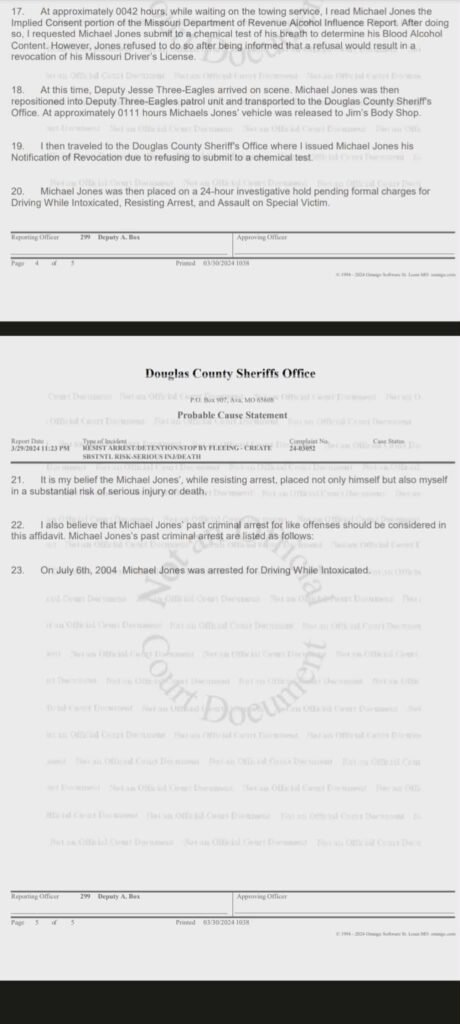
AVA, MO — In a case that raises significant questions about police transparency and jurisdictional boundaries, the Missouri Free Press has obtained a Probable Cause (PC) Statement and conflicting body camera footage regarding the March 30, 2024, arrest of Michael Jones. While Deputy Aaron Box of the Douglas County Sheriff’s Office swore under penalty of law that Jones resisted arrest and operated a vehicle while intoxicated, the digital evidence suggests a different sequence of events.
The “Intoxicated” Operator: A Stationary Sleeper?
Deputy Box’s sworn statement alleges that Jones “operated a motor vehicle while in an intoxicated condition.” However, the deputy’s own narrative admits that when he first located the Chevy truck at approximately 0000 hours, it was “in the roadway at the end of County Road 517,” a dead-end road blocked by a metal gate. Box notes he found Jones “unconscious in the driver’s seat” with “extremely loud music” playing.
The Discrepancy:
Under Missouri law (RSMo 577.010), “operating” a vehicle traditionally requires the engine to be running or for the individual to be in a position to exert control over a moving vehicle. While Missouri courts have occasionally ruled that a DWI can occur on private property, the threshold for “probable cause” remains high.
The Tip:
Box cites a 911 call from a reporting party who “believed” the driver was intoxicated. The Evidence: There is no record of a field sobriety test or a breathalyzer being conducted prior to the use of force.
The Video: Body camera footage shows Jones asleep. When he wakes and moves, the truck rolls slightly downhill—not because he is “operating” it, but because the vehicle was not in park or the brake was not engaged.
Jurisdictional Overreach?
Property records and Life360 data provided by the family indicate that the arrest occurred inside Webster County, not Douglas County. Under RSMo 57.111, a deputy typically only has the power of arrest in an adjoining county if “expressly requested” by that county’s sheriff. There is no mention in the PC statement of a request for assistance from Webster County.
Resisting or Reeling?
The Use of Force The most jarring contradiction occurs during the escalation of force. Deputy Box charged Jones with a Class E Felony for Resisting Arrest, claiming Jones “attempted to prevent the officer from effecting the arrest.”
What the PC Statement says:
Jones allegedly replied “fuck the e brake” and threatened to “roll you [the deputy] down the hill.” Box claims Jones “failed to comply” and “tensed his body” when ordered to put his hands behind his back. Box utilized a Taser twice, released a K9 unit, and finally applied a Vascular Neck Restraint (VNR) to incapacitate Jones.
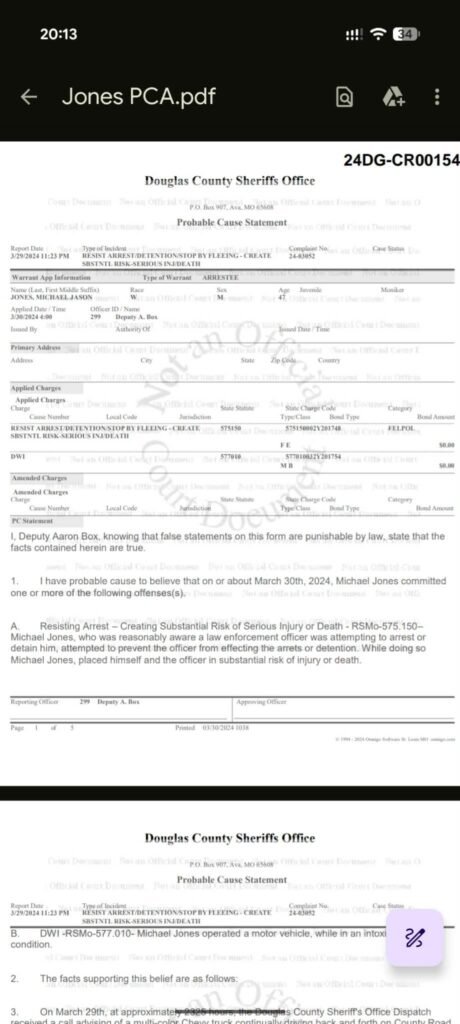
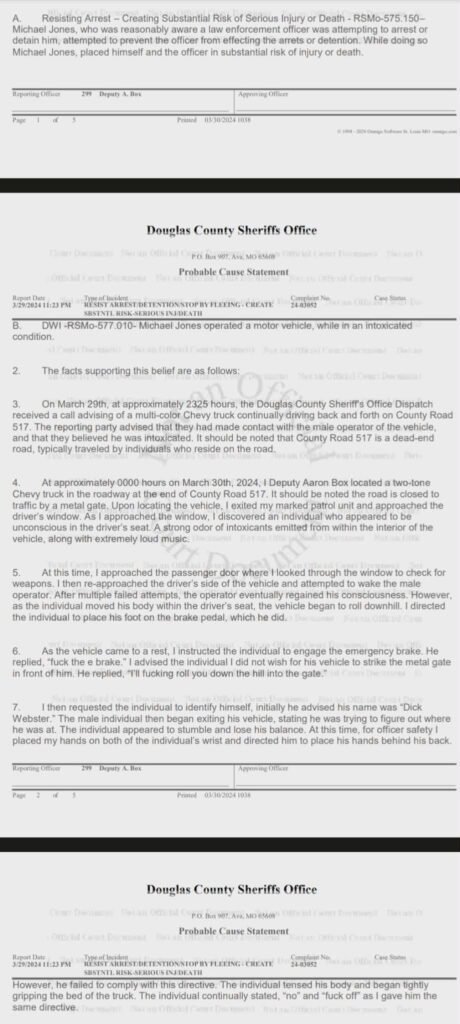
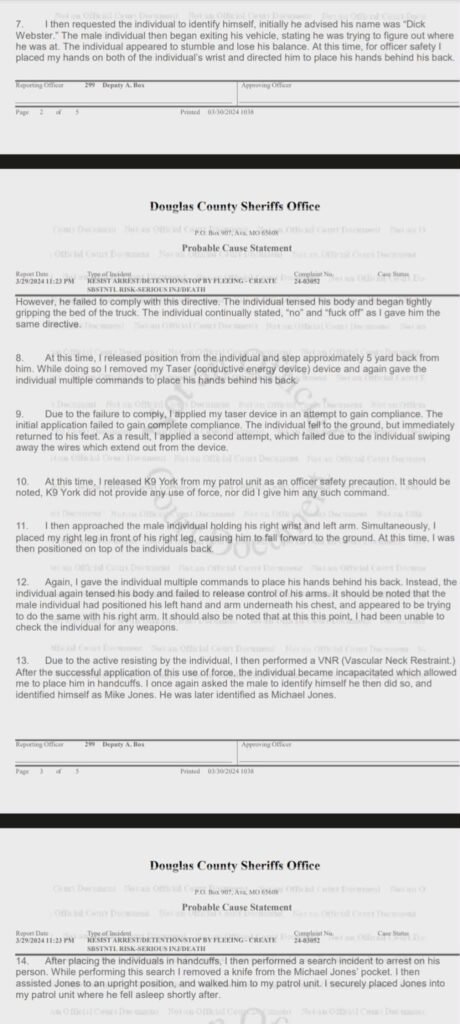
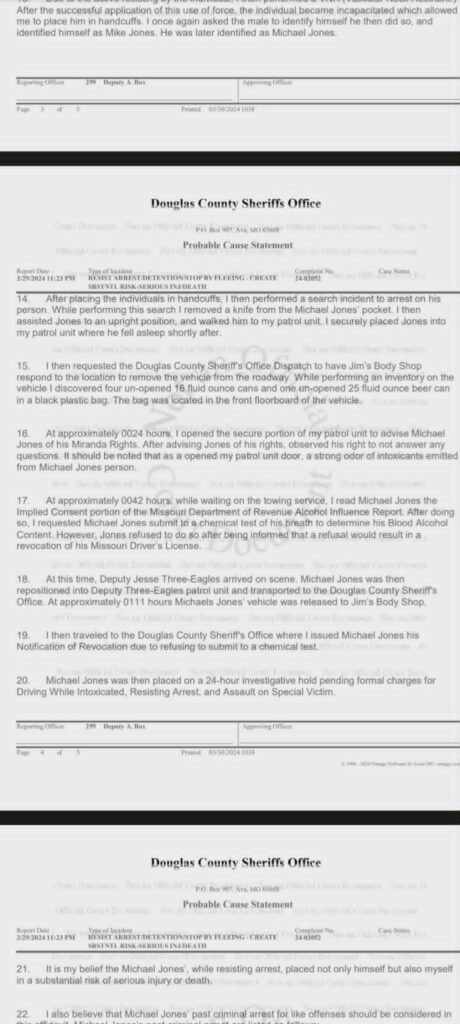
What the Video shows:
The video depicts a disoriented man waking up to a flashlight in his eyes. When ordered to put his hands behind his back, Jones questions the order—a right protected under the Fourth Amendment when the legality of a detention is unclear.
Compliance: As Box draws his Taser, Jones is seen putting his hands in the air.
Deployment: Despite the visible attempt to comply, Box fires the Taser.
The K9: While Jones is on the ground, the K9 unit is released.
The Hold: Box admits to using a VNR—a “chokehold” technique that has faced intense scrutiny and legislative bans in several jurisdictions due to the risk of serious injury or death.
The Plea of the Unrepresented
Despite the clear discrepancies between the sworn statement and the video, Michael Jones accepted a plea deal. Jones informed the Missouri Free Press that he felt forced to settle because he “could not afford an attorney” to challenge the deputy’s version of events in court.
Under RSMo 575.150, a person must “know or reasonably should know” they are being arrested or detained for a “resisting” charge to hold. If the deputy never stated Jones was under arrest, and the video shows Jones attempting to raise his hands, the felony charge of creating a “substantial risk of serious injury” may have been an inflation of the facts.