By MOFreePress
Records obtained by MIssouri Free Press show the Maries County Sheriff’s Office confirmed that, as of August 2024, no policy existed governing when deputies were required to complete reports.
The revelation came during a Sunshine Law request submitted by Mo Free Press while investigating the death of Logan Edward Atterberry.
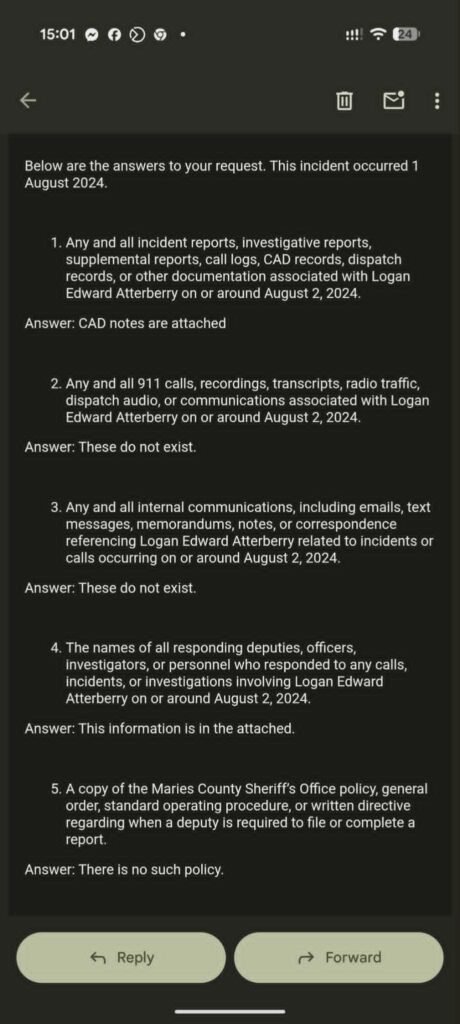
MOFreePress requested incident reports, investigative reports, supplemental reports, dispatch audio, radio traffic, internal communications, CAD records, and any departmental policy governing when deputies are required to complete reports.
The department’s response was striking.

According to the Sheriff’s Office, no investigative reports, supplemental reports, radio communications, recordings, transcripts, or internal communications existed in connection to the incident. The department stated only CAD notes were available.
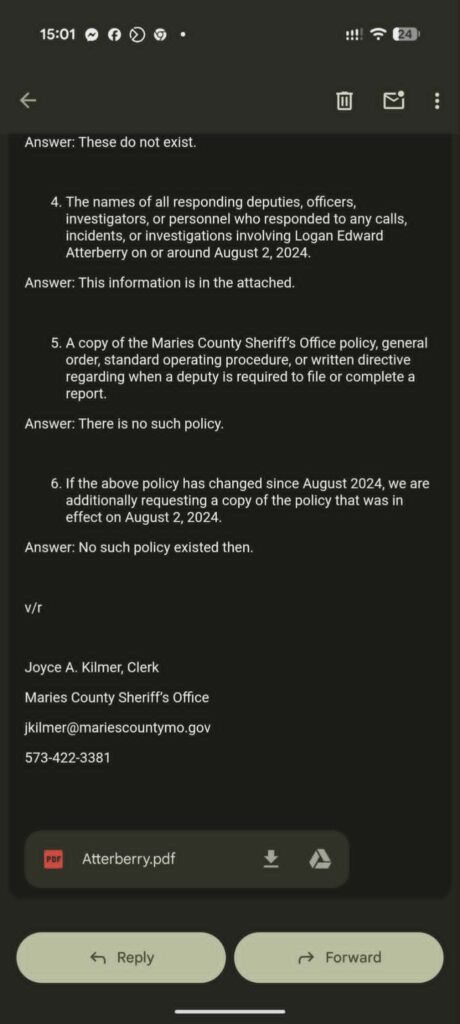
When asked for: “A copy of the Maries County Sheriff’s Office policy, general order, standard operating procedure, or written directive regarding when a deputy is required to file or complete a report,”
the department responded: “There is no such policy.”
MOFreePress then asked whether such a policy may have existed at the time of the incident and later changed.
The response: “No such policy existed then.”
Despite the department stating that virtually no responsive records existed beyond a single sheet of CAD notes, Mo Free Press was still charged for the records request.
MOFreePress had previously been informed that deputies responded to the scene and that Logan Atterberry was later life flighted for medical treatment.
A former Maries County deputy also told Mo Free Press that deputies were not required to complete reports when responding to medical scenes.
Seeking clarification, MOFreePress later contacted the Marie’s County Sheriff, Mark Morgan, directly and asked whether he intended to create a policy governing when deputies are required to file reports.
The sheriff did not dispute the absence of policy. Instead, he defended the practice.
According to the sheriff, deputies are encouraged to use “sound judgement” when determining whether a report should be filed. He further stated that law enforcement contains “too many uncertainties” to create a specific reporting policy outlining or “micromanaging” how every call should be handled.
That response may now become central to a broader public debate surrounding accountability, documentation, and transparency within rural Missouri law enforcement agencies.
Critics argue that without formal reporting standards, documentation becomes discretionary. In practice, that means incidents involving law enforcement response may occur without any requirement that deputies formally document what happened, what they observed, what actions were taken, or what evidence existed at the scene.
Incident reports are often foundational to later investigations. They preserve timelines, observations, witness statements, and actions taken by responding personnel. Without mandatory reporting requirements, potentially important details may never become part of the official record.
The issue also raises broader statewide questions.
Missouri law appears to provide sheriffs broad discretion over departmental operations, yet there does not appear to be any statewide requirement compelling sheriff’s departments to maintain standardized operational policies governing report writing and documentation practices.
MOFreePress spoke with other agencies in the region while examining the issue. Sunrise Beach Police Chief Scott Craig stated that when he arrived at that department, no such policy existed there either, and that he worked to establish the department’s current reporting policies and operational standards.
According to Chief Craig, Sunrise Beach policy requires reports when an officer believes a crime has been committed, along with several specifically defined situations where reports are mandatory.
The contrast highlights what some transparency advocates describe as a larger structural issue within parts of rural law enforcement: the absence of statewide baseline standards requiring agencies to maintain clear written policies governing documentation and accountability.
To many members of the public, the concern is no longer limited to a single case.
The concern is how many incidents across Missouri may have occurred without reports, without documentation, and without any policy requiring either.
Maries County’s own response, “No such policy existed,” may now become central to that conversation.