By MOFreePress
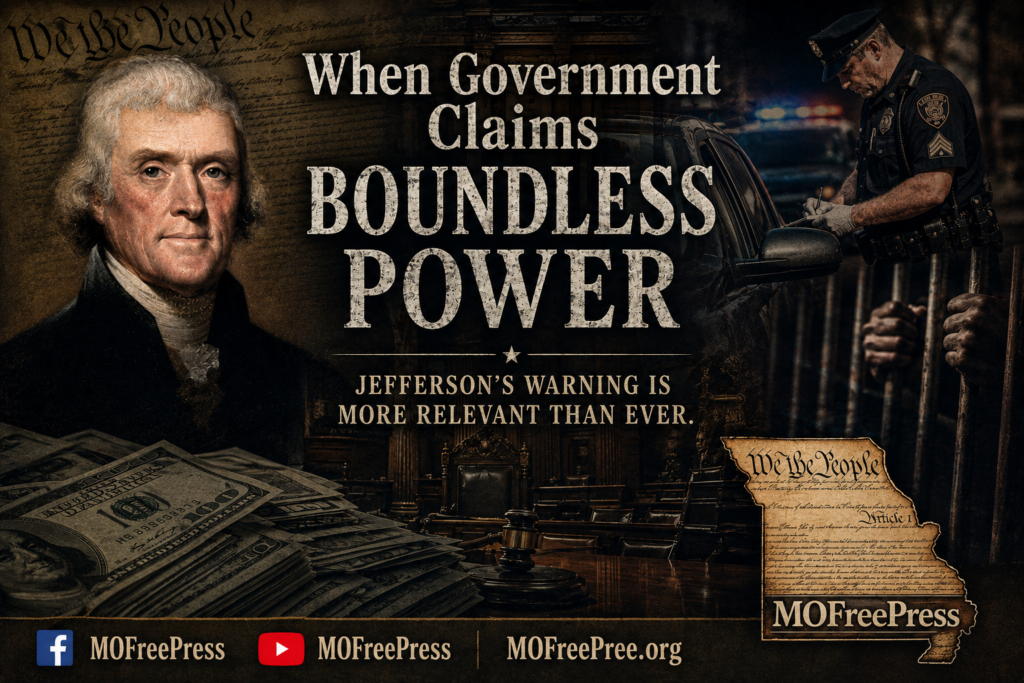
More than 225 years ago, Thomas Jefferson warned Americans about something he believed could destroy liberty from within.
“To take a single step beyond the boundaries thus specially drawn around the powers of Congress, is to take possession of a boundless field of power.”
Jefferson believed the federal government possessed only the powers specifically delegated by the Constitution. Once government officials began stretching constitutional language to justify actions beyond those limits, he feared there would be no meaningful restraint on state power.
That belief shaped Jefferson’s opposition to the First Bank of the United States. He argued the Constitution did not explicitly authorize Congress to create a national bank and therefore Congress had no authority to do so.
As Jefferson wrote:
“The incorporation of a bank and the powers assumed by this bill have not, in my opinion, been delegated to the United States by the Constitution.”
To Jefferson, this was never just about banking. It was about precedent. If the federal government could assume powers simply because they were useful or convenient, then constitutional limits would gradually become meaningless.
That debate from the 1790s now echoes through nearly every modern political argument in America.
Today, many Americans across the political spectrum increasingly believe government has become too large, too expensive, too punitive, and too insulated from accountability.
The concerns are no longer limited to banks or the Alien and Sedition Acts. The modern debate now includes:
- rising taxes,
- endless fees and permits,
- aggressive policing for revenue,
- civil asset forfeiture,
- mass incarceration,
- privatized prisons,
- and a justice system many citizens no longer trust equally applies the law.
From Enumerated Powers to Endless Expansion
Jefferson believed the Constitution created a federal government of limited and enumerated powers. Any powers not specifically delegated remained with the states or the people under the 10th Amendment.
His political rival, Alexander Hamilton, viewed the Constitution very differently.
Hamilton argued the federal government possessed implied powers beyond those specifically listed in the Constitution. If an action helped carry out an enumerated power such as taxation, commerce, or national finance, then Congress could constitutionally pursue it.
That clash between Jefferson and Hamilton never truly ended.
Over time, Hamilton’s broader interpretation largely prevailed. Federal authority expanded through Supreme Court decisions, wars, economic crises, and the growth of federal agencies.
Entire bureaucracies emerged that the Founders could never have imagined.
Supporters argue modern federal power is necessary to govern a complex nation of more than 330 million people. Critics argue those same systems have evolved into sprawling administrative structures that regulate nearly every aspect of American life while producing enormous debt, inefficiency, and declining public trust.
Today Americans are taxed not only through income taxes, but through:
- property taxes,
- sales taxes,
- fuel taxes,
- licensing fees,
- court costs,
- tolls,
- permits,
- municipal fines,
- and countless other direct and indirect forms of taxation, fees, assessments, and government revenue collection.
For many working class families, government no longer feels limited. It feels constant.
The Kentucky Resolutions and the Madison Debate
Jefferson’s most controversial constitutional argument emerged in response to the Alien and Sedition Acts.
Believing the federal government had exceeded its constitutional authority, Jefferson secretly drafted the Kentucky Resolutions.
The resolutions introduced the idea that states could declare federal laws unconstitutional if those laws exceeded delegated powers. This became known as the doctrine of nullification.
Jefferson viewed the Constitution as a compact among sovereign states. Because the states created the federal government, he argued the states retained the authority to judge constitutional violations.
But even Jefferson’s ally, James Madison, stopped short of fully embracing that position.
Madison helped author the Virginia Resolutions and agreed the federal government could violate constitutional limits. However, Madison later argued states could protest, challenge, and interpose against federal overreach, but could not unilaterally invalidate federal law on their own authority.
That distinction became enormously important in later American history.
Jefferson’s nullification theory would later be used by states resisting tariffs, federal authority, civil rights enforcement, and ultimately by secessionists leading into the American Civil War.
Ironically, ideas Jefferson originally advanced in defense of civil liberties were later invoked by others to defend segregation and slavery.
When Justice Becomes Revenue
One of the strongest modern echoes of Jefferson’s warnings can be found in the criminal justice system.
Across the country, municipalities have repeatedly faced accusations that fines, citations, and court fees are being used less for public safety and more as sources of government revenue.
Critics argue this creates dangerous incentives where enforcement volume becomes financially valuable to local governments.
National scrutiny intensified after the Ferguson unrest, where federal investigators found municipal courts and policing practices heavily tied to revenue generation.
Missouri itself has faced repeated criticism over:
- excessive municipal fines,
- low level citation enforcement,
- court debt cycles,
- and overcrowded jails.
To critics, these systems resemble exactly the type of expanding governmental machinery Jefferson warned about: institutions that gradually grow beyond their original purpose while becoming increasingly difficult for ordinary citizens to challenge.
Privatized Prisons and Perverse Incentives
The rise of privatized prisons added another layer to the debate.
Private prison companies generate profit from incarceration itself. Critics argue this creates an unavoidable conflict of interest where keeping prison populations high directly benefits corporations financially.
Supporters argue privatization can lower costs and improve efficiency.
Opponents counter that incarceration should never become a profit driven industry.
Historically, imprisonment itself was once viewed far differently than it is today. Early American constitutional debates surrounding punishment focused heavily on the United States Constitution prohibition against “cruel and unusual punishments” under the Eighth Amendment. At various points in early legal history, long term imprisonment was itself viewed by some legal thinkers as potentially inhumane, psychologically destructive, or incompatible with the principles of a free society.
Over time, however, incarceration evolved from a relatively limited punishment into one of the central enforcement mechanisms of modern government.
The United States now maintains one of the largest incarcerated populations in the world.
Whether public or private, many Americans increasingly question whether the justice system is truly focused on rehabilitation and public safety or whether it has evolved into a self sustaining bureaucratic system fueled by arrests, probation fees, inmate labor, and long term supervision.
A Bipartisan Distrust of Institutions
Distrust of institutions is no longer isolated to one political ideology.
Many Americans on the left criticize:
- corporate influence,
- mass incarceration,
- aggressive policing,
- and economic inequality.
Many Americans on the right criticize:
- federal overreach,
- unelected bureaucracies,
- excessive taxation,
- and erosion of constitutional protections.
Increasingly, independents distrust both sides.
The result is a growing belief among many citizens that the system often protects itself before it protects the public.
Jefferson’s Question Still Matters
More than two centuries later, Jefferson’s central question remains unresolved:
How much power should government possess before liberty begins to erode?
For some Americans, modern government is a necessary safeguard against disorder and inequality. For others, it has become too large, too expensive, and too insulated from accountability.
Either way, Jefferson’s warning about “boundless power” continues to resonate because many citizens increasingly feel powerless inside systems they cannot influence, afford, or escape.
The debate did not end with the Founding Fathers.
It simply evolved.