By Corey Thompson, MoFreePress
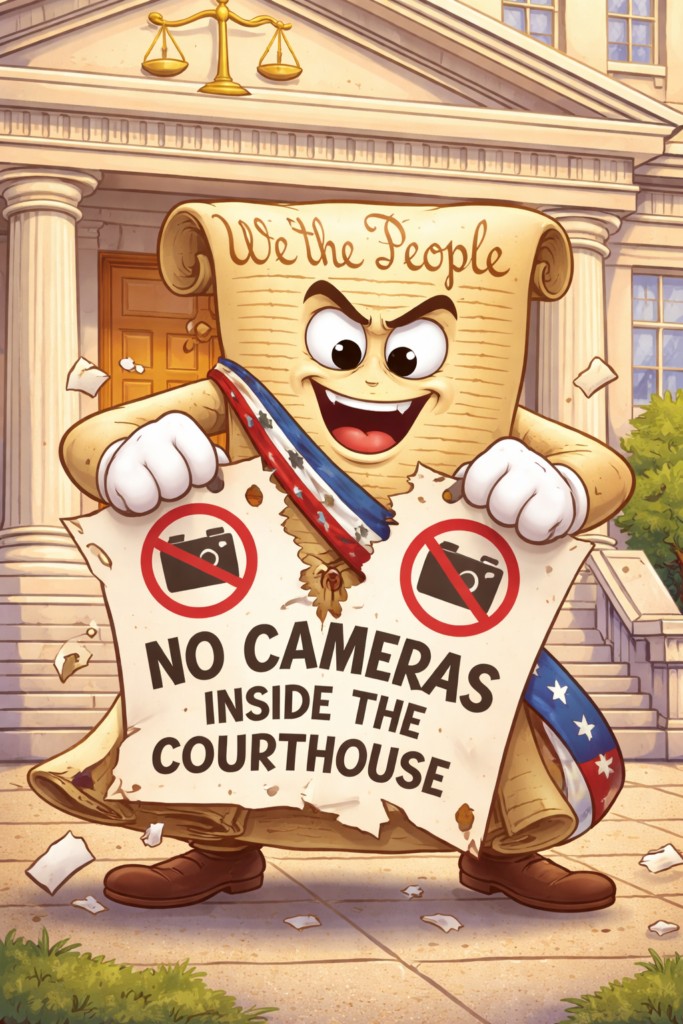
Residents and transparency advocates are raising concerns over what appears to be a blanket prohibition on recording devices inside multiple courthouses across the Lake of the Ozarks region, including Morgan County, Miller County, and Camden County.
According to individuals familiar with courthouse policies, the restrictions are not limited to courtroom proceedings, but extend broadly to courthouse facilities themselves. That distinction is at the center of growing constitutional concerns.
First Amendment Implications
At issue is whether a blanket ban on recording devices inside public courthouse buildings violates First Amendment protections for speech, press, and the right to gather information about government operations.
The U.S. Supreme Court has long recognized that judicial proceedings exist within a framework of public accountability and transparency. In Richmond Newspapers, Inc. v. Virginia (1980), the Court affirmed that court proceedings are presumptively open to the public, emphasizing the historical tradition of open courts as a structural safeguard of liberty.
While courts do have authority to regulate conduct inside courtrooms, legal precedent suggests that restrictions must be narrowly tailored and supported by specific governmental interests, such as maintaining order, protecting witnesses, or ensuring fair trials.
Recording Public Officials in Public Spaces
Outside the courtroom itself, federal appellate courts have increasingly recognized that individuals have a First Amendment right to record public officials performing official duties in public spaces.
In Glik v. Cunniffe (1st Cir. 2011), the court held that recording government officials in public is a protected form of informational gathering and expression. Similarly, Fields v. City of Philadelphia (3d Cir. 2017) reinforced that the First Amendment protects the right to record matters of public concern, including the actions of government employees.
These cases do not eliminate the ability of courts to enforce reasonable restrictions, but they do raise serious questions about blanket bans that apply broadly across entire public buildings without distinction between secure courtrooms and public access areas such as lobbies, clerk counters, or hallways.
Concerns Over Blanket Policies
Legal observers note that while courtroom-specific restrictions are common and often upheld, courthouse-wide prohibitions on recording devices are more legally vulnerable, particularly when they are not narrowly tailored or justified by specific findings.
The concern is not about disrupting court proceedings, but about whether public access to observe and document government operations is being restricted beyond what the Constitution allows.
Potential Legal Exposure
If challenged, policies that impose broad prohibitions on recording activity in public areas of government buildings may face scrutiny under 42 U.S.C. § 1983, which allows individuals to sue state or local officials for constitutional violations conducted under color of law. Prevailing plaintiffs may also be entitled to attorney’s fees, significantly increasing the financial risk to local governments that maintain unconstitutional policies.
Similar restrictions have been challenged in other jurisdictions. In New York, First Amendment auditor Sean Paul Reyes (known online as “Long Island Audit”) litigated a policy restricting recording inside police facilities. Federal litigation in that matter resulted in injunctive relief limiting enforcement of the policy in certain public-access areas, with courts analyzing the issue through First Amendment forum doctrine and applicable state “right to record” protections.
While outcomes vary depending on jurisdiction and specific facts, the Reyes litigation illustrates a broader legal reality: blanket prohibitions on recording in public government facilities are increasingly subject to constitutional challenge, and when successfully challenged, can result in injunctive relief and attorney’s fees against the government entity involved.
Local Efforts Underway
Efforts are now underway in Morgan County to address the issue directly with local officials in hopes of resolving the matter without litigation.
Advocates say the goal is not confrontation, but correction. Ensuring that county policies align with constitutional standards before the issue escalates into federal court disputes that ultimately cost taxpayers.
As similar policies appear to exist in multiple counties across the region, observers expect the issue may not remain localized for long.